South Dakota Art Museum Showcases Statewide Impact, New Exhibitions and Nordic Yule Market at Brookings Rotary
BROOKINGS, S.D. — [Date] — Brookings Rotary members recently heard how the South Dakota Art Museum, located on the South Dakota State University campus, is expanding its role as the state’s premier visual arts resource while serving more than 55,000 people each year through exhibitions, education and outreach.
The museum, founded in 1970 and accredited by the American Alliance of Museums since 1977, now cares for a collection of about 7,000 works of art. That collection includes iconic South Dakota artists Harvey Dunn, Paul Goble and Oscar Howe, as well as Native American works, South Dakota contemporary artists, and nationally known names such as Andy Warhol. The museum has also recently begun building a Greco-Roman pottery collection.
“We inspire creativity, connect people and enrich lives through art,” the museum’s director told Brookings Rotary. “We serve the people and communities of South Dakota and our visitors as the state’s premier visual arts resource, and everything we do is grounded in that mission.”
Deep Roots and National Recognition
The idea for an art museum in South Dakota began with the General Federation of Women’s Clubs around 1900, when club members collected art and mailed it around the state so residents could experience culture on the frontier. Serious conversations about a permanent museum began around 1948.
Several locations were considered, but in 1957 the state approved legislation to place the museum on a university campus. SDSU and the University of South Dakota both campaigned to host it; ultimately the museum was awarded to South Dakota State University.
In 1970 the South Dakota Art Museum opened its doors. The museum’s advisory board was formed in 1969, and its community guild was established in 1971. In 1977 it became the first museum in the state to earn accreditation from the American Alliance of Museums — a distinction it still holds as one of only a few accredited institutions in South Dakota.
“That accreditation ensures we follow the highest standards for collections care, exhibitions, education and operations,” the director said. “It’s a recognition of quality that helps us build partnerships and bring in major exhibitions.”
Collections, Care and Campus Support
All 7,000 works in the collection are housed in three secure storage areas in the lower level of the museum in Brookings. Strict climate control, security systems and handling procedures protect the artworks, especially light-sensitive works by artists such as Oscar Howe.
Harvey Dunn’s paintings are central to the museum’s story. After a major exhibition in De Smet 75 years ago, Dunn donated his works to SDSU—helping cement the university as the future home of the museum. Today, the museum holds 147 Dunn works.
“People sometimes ask why more Harvey Dunn or Oscar Howe works aren’t always on display,” the director explained. “We have to balance a 7,000-piece collection, protect light-sensitive works and still make room to share other artists and stories with our visitors.”
SDSU provides approximately half of the museum’s operating support, including salaries for full-time staff, the building, utilities and campus services such as human resources. Additional support comes from the National Endowment for the Arts through the South Dakota Arts Council, museum store sales and museum members and donors.
“Because SDSU covers most of our core operations, the dollars given by members and donors go directly to exhibitions, programs and outreach,” the director said. “That’s where our impact is most visible in communities across the state.”
Strategic Plan Focused on Access, Inclusion and Sustainability
The museum’s current three-year strategic plan (2024–2026) aligns with SDSU’s “Pathway to Premier 2030” initiative and centers on three primary goals:
Increase engagement statewide as both the campus art museum and the state art museum.
Increase inclusivity and accessibility by promoting belonging and removing barriers—such as parking confusion, campus intimidation and cost.
Create a sustainable, thriving ecosystem that supports both the physical care of the collection and the well-being of staff, while ensuring long-term financial health.
“It can be intimidating for people who don’t come from college-going families to set foot on campus,” the director noted. “We’re designing programs and communications that make it easier to know where to park, where to go and what to expect, so everyone feels welcome at the art museum.”
Education, Field Trips and Virtual Outreach
The museum now offers more than 218 programs annually—up from fewer than 50 just a few years ago—with only one additional program staff member. Program participation has increased by 68%, including a more than 300% increase in SDSU student engagement since 2021.
A key tool is Visual Thinking Strategies, a discussion method used in the galleries and in classrooms that builds critical thinking and community through shared looking and conversation. The museum also offers robust field trip experiences that combine tours, discussion and hands-on artmaking—plus travel scholarships of $5 per student to help cover transportation and substitute-teacher costs.
“We don’t want the price of a bus to be the reason kids can’t come to the museum,” the director said. “Thanks to donors, all of our education and outreach programs are free.”
For schools too far to visit in person, the museum offers virtual field trips developed in partnership with Art Bridges and South Dakota Public Broadcasting. Teachers can access videos on SDPB’s website and the museum’s YouTube channel, receive free boxes of art supplies for their classes, and connect live with museum educators via Zoom.
One memorable virtual field trip reached students on a reservation at the bottom of the Grand Canyon in Arizona. Art supplies had to arrive by mule train.
“Our impact truly travels,” the director said. “Those kids experienced South Dakota art and created their own work, all from their classroom at the bottom of the canyon.”
Community Programs and Nordic Yule Market
The museum hosts Community Art Days, family fun days, “hygge” days and the popular Anderson Plaza Summer Performance Series, which brings people together outside the museum for live music and relaxed summer evenings. Staff also bring free art activities to community events such as Downtown at Sundown and the Insect Festival.
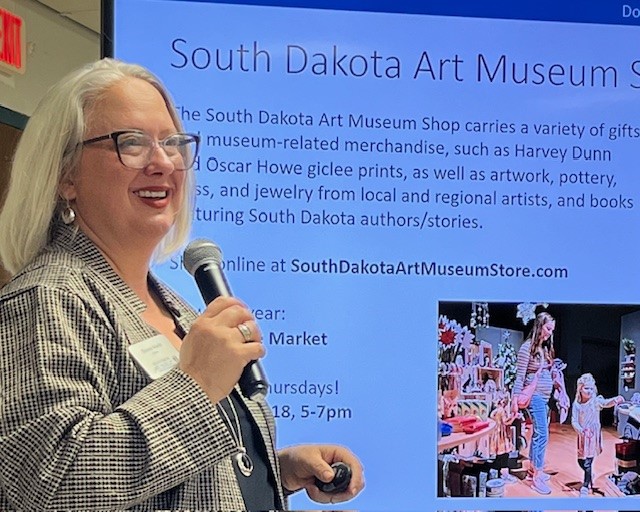
This winter, the museum store has expanded into a Nordic Yule Market, aligned with the current exhibition Nordic Echoes. One gallery has been transformed into a cozy shopping space featuring Nordic handcrafts, specialty foods and gift items. The store generates about 20% of the museum’s annual funding.
Shoppers can also enjoy special events such as a “Sip and Shop” on December 18, complete with Santa photos by the (decorative) fireplace, gift wrapping and wish lists to make holiday shopping easier.
Exhibitions on View and Coming Soon
The current exhibition Nordic Echoes, organized by the American-Scandinavian Foundation in New York City, is on view through January 3. The South Dakota Art Museum is the exhibition’s first stop after its New York premiere, reflecting the museum’s growing national reputation. Many of the featured artists are from the region, including Minnesota and western South Dakota, and work in traditional Scandinavian crafts such as woodcarving and weaving.
Visitors can also see the Hornet Collection, which includes several Harvey Dunn works, and an exhibition of the museum’s own textile collection—featuring rarely seen pieces such as Navajo rugs.
Next up is Color and Context: Red, a contemporary quilt exhibition opening January 24.
“We invite everyone to come spend time with us,” the director said. “Whether you’re here for a quiet moment with a favorite Harvey Dunn, a family art activity or some cozy holiday shopping, the South Dakota Art Museum belongs to you.”